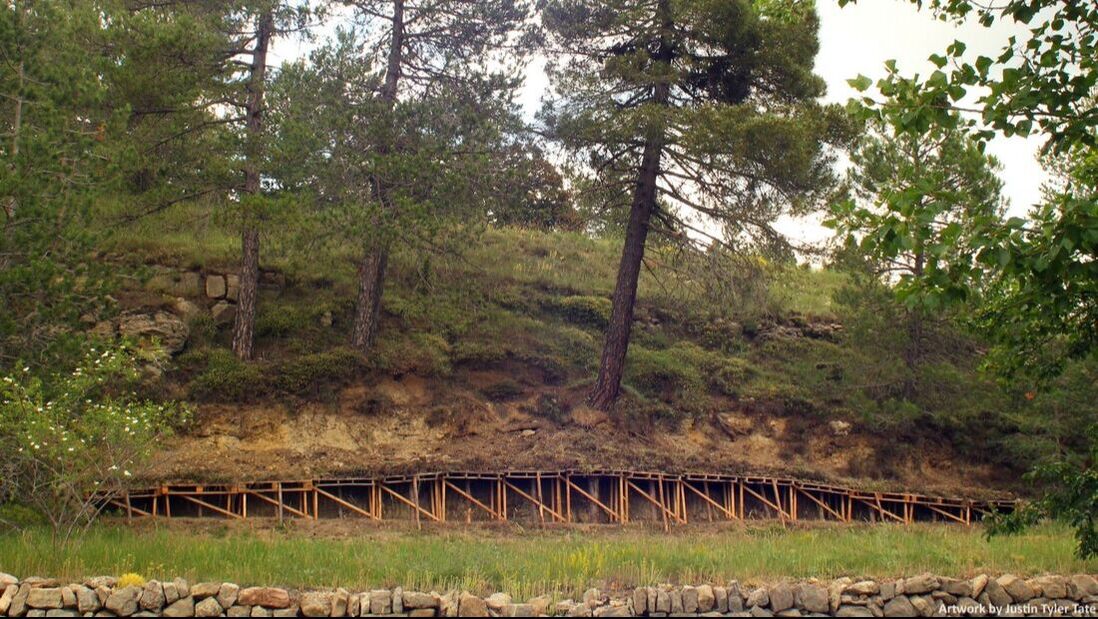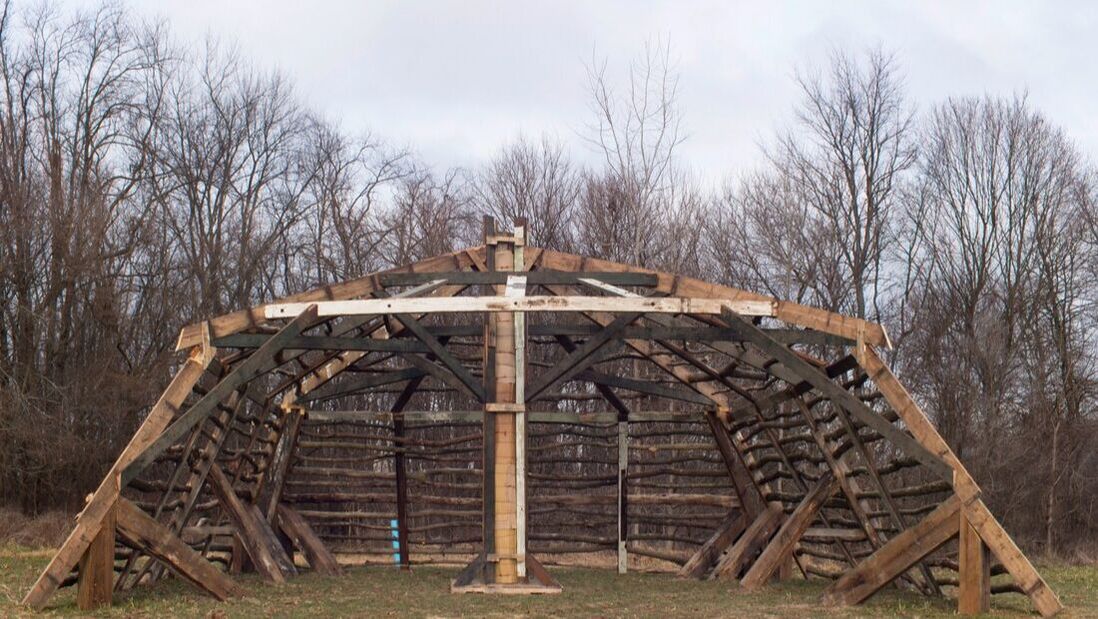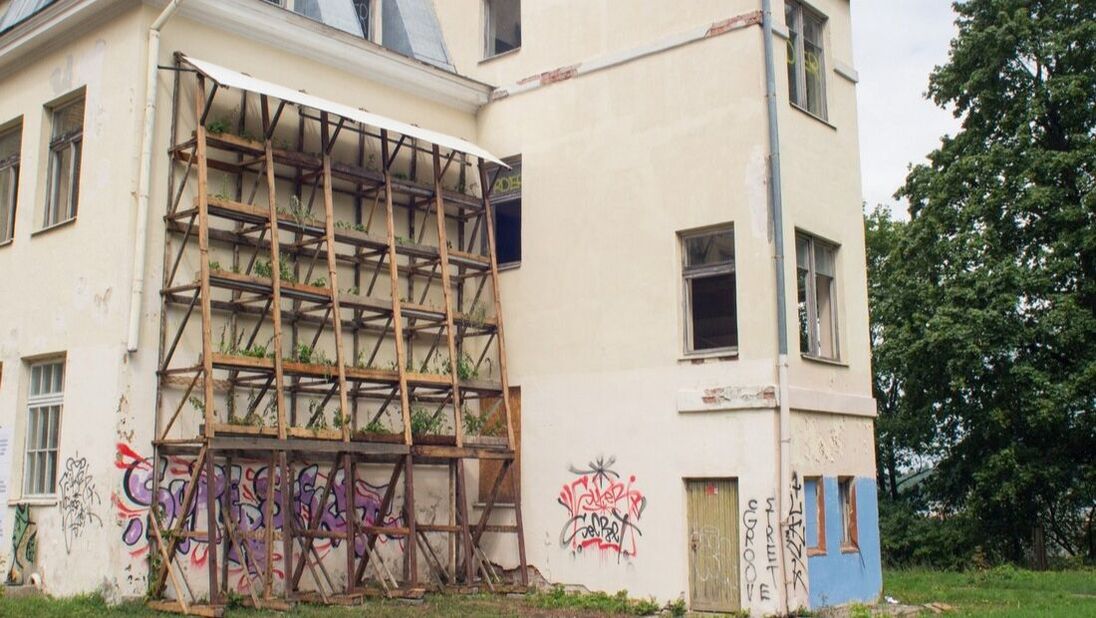
Three months were spent at Nordic Artist’s Center Dale, researching and writing about Post-Anthropocene Architecture, but also experimenting with it as a series of quick sketches in space-time. These sketches are limited by landscape, materials, physics, time and tools. In each instance, the landscape was explored to find areas with usable natural materials, within a relatively small area. With those available materials, sketches were created by stacking, leaning, fitting and otherwise assembling them. Through their construction, materials were neither brought into nor removed from the forest, but simply reorganized.
Each sketch is improvised at its site and as such - in addition to looking for a suitable location with nearby materials - the process of its construction necessitates an extensive questioning of: Which non-human species are its intended users? How will they use it? How does it add capacity to the local environment (rather than being redundant or unnecessary)? As well as, how will its users contribute to and modify its construction?
The repetitiveness of the Post-Anthropocene Architecture sketches produced in Dale is a useful research methodology because it provides innumerable opportunities for critical analysis, developing varied approaches, a crystallization of philosophy and understanding the local environment. It is through time spent doing, reflecting and repeating that provides a potential for mastery. By working immersed in as well as collaborating with the local biome, a process of discovery is undertaken whereby the design and conceptualization of each new sketch is increasingly difficult. This is due to trying to address new and different needs within the environment, while making an effort not to create redundant structures, as well as not constructing sketches too close together. But that increasing difficulty comes only through an intimate relationship developed with the landscape in combination with a thorough understanding of Post-Anthropocene Architecture.
The process of creating these sketches embraces the limitations of their creation in order to simply but efficiently test, research and manifest hyper-site-specific examples of Post-Anthropocene Architecture.
Each sketch is improvised at its site and as such - in addition to looking for a suitable location with nearby materials - the process of its construction necessitates an extensive questioning of: Which non-human species are its intended users? How will they use it? How does it add capacity to the local environment (rather than being redundant or unnecessary)? As well as, how will its users contribute to and modify its construction?
The repetitiveness of the Post-Anthropocene Architecture sketches produced in Dale is a useful research methodology because it provides innumerable opportunities for critical analysis, developing varied approaches, a crystallization of philosophy and understanding the local environment. It is through time spent doing, reflecting and repeating that provides a potential for mastery. By working immersed in as well as collaborating with the local biome, a process of discovery is undertaken whereby the design and conceptualization of each new sketch is increasingly difficult. This is due to trying to address new and different needs within the environment, while making an effort not to create redundant structures, as well as not constructing sketches too close together. But that increasing difficulty comes only through an intimate relationship developed with the landscape in combination with a thorough understanding of Post-Anthropocene Architecture.
The process of creating these sketches embraces the limitations of their creation in order to simply but efficiently test, research and manifest hyper-site-specific examples of Post-Anthropocene Architecture.
|
|
|
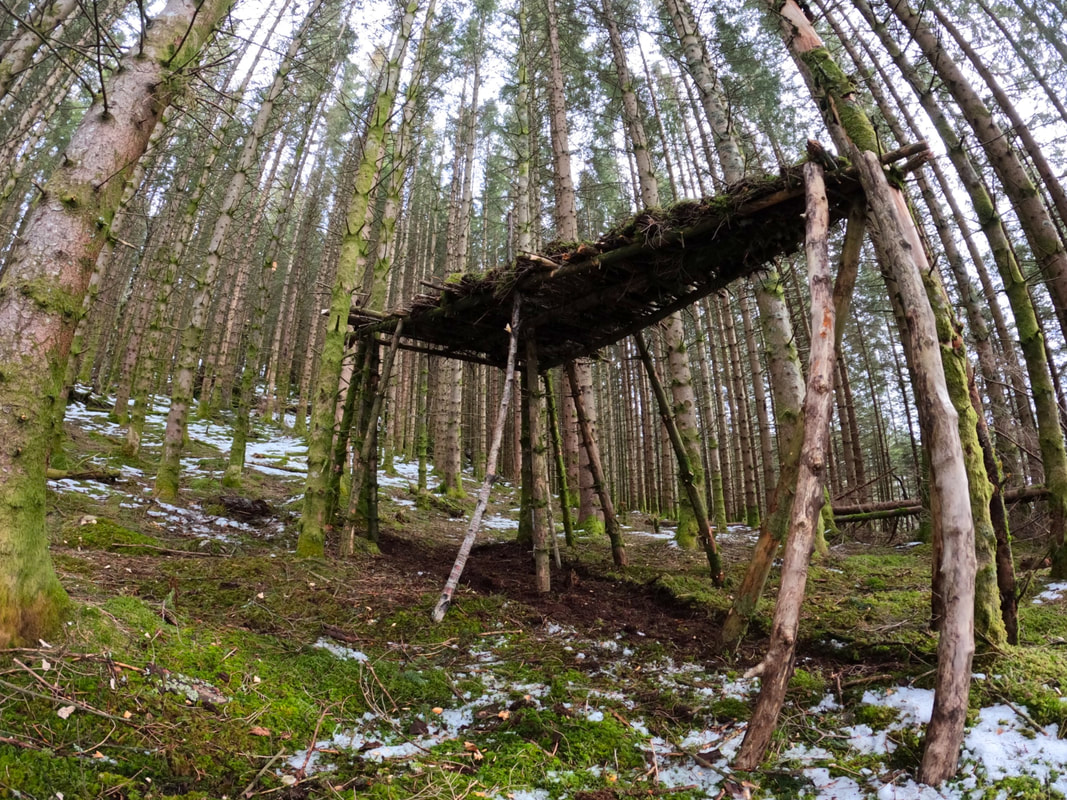
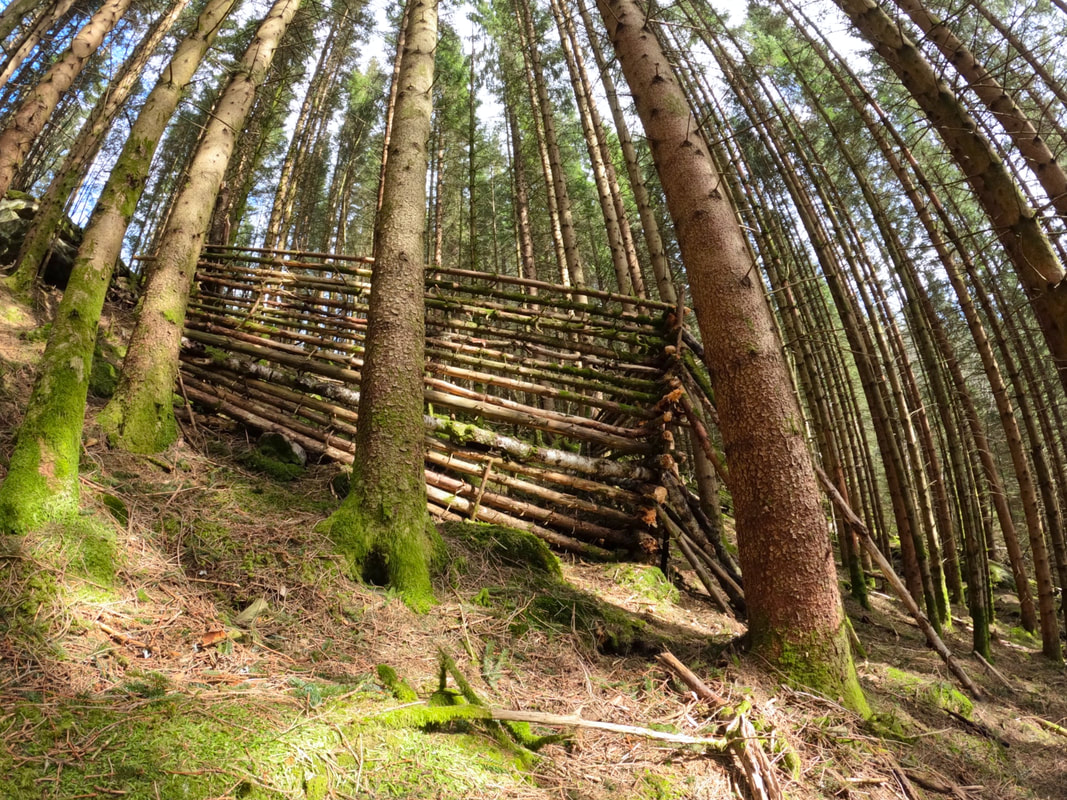
PAA Sketch #001: Moss-Loft
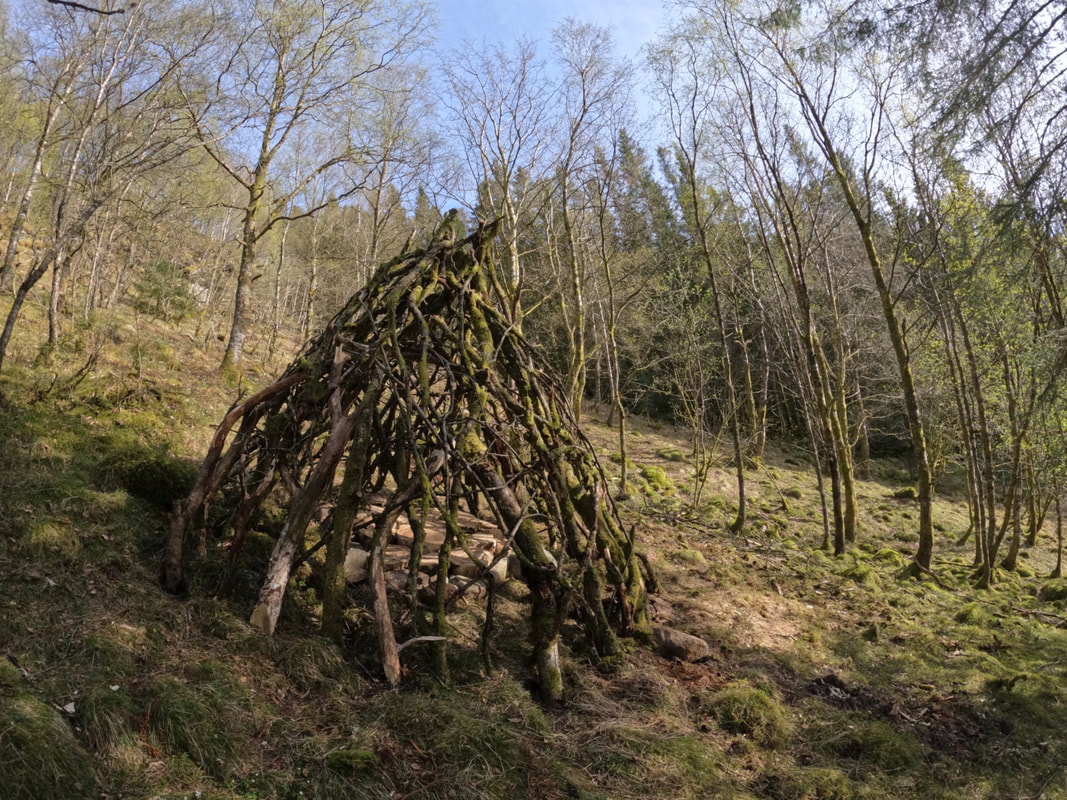
Tools: A hatchet Materials: Found dead trees and moss Dimensions: 5.6m x 3.3m x 2.5m Time: 2022-04-11, ~5 hours Location: 61.35786, 5.41016 Notes: This sketch is an elevated platform - using nothing but gravity, pressure, and the materials themselves - to suspend a bed of moss in the air. Given time, the moss will spread and occupy all of the materials that comprise the structure, starting with the bed and then migrating down into the structural poles. As the moss and time break down the structure, it will eventually fall back to the ground and melt back into its original place. |
PAA Sketch #002: Weir
Tools: A hatchet Materials: Found dead trees and forest debris Dimensions: 5.5m x 6m x 3m Time: 2022-04-16, ~5 hours Location: 61.35781, 5.40718 Notes: Weir as its name suggests is a weir, but made for the purpose of collecting the forest’s natural debris. Situated on the side of a steep hillside, the sketch utilizes gravity to pull leaves, branches and other detritus into its embrace. Weir thus becomes a collection point for biological waste - through the collection of which creates a site of enhanced microbial and mycelial activity. As the forest’s debris accumulates and is broken down, Weir establishes a situation of human and nonhuman collaboration while also working with the natural qualities of the landscape, in order to modify the existing terrain. |
|
|
|
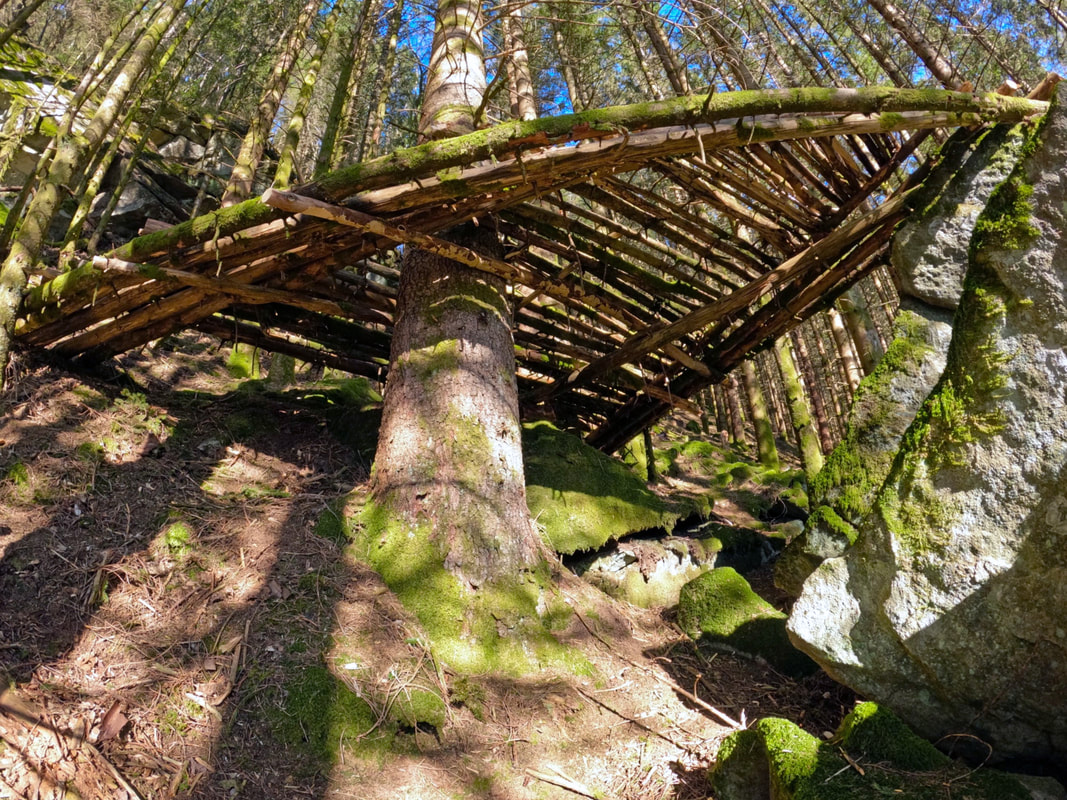
PAA Sketch #003: Small Game Refuge
Tools: A hatchet and hand saw Materials: Found dead trees and forest debris Dimensions: 5.7m x 6.6m x 2.5m Time: 2022-04-18, ~8 hours Location: 61.35802, 5.40619 Notes: This sketch, constructed on the side of a steep hill and adjacent to a game trail, acts as a covering and platform which bridges the sloping land with a nearby grouping of boulders and rocks. Although the structure is completely covered by branches, a narrow opening is left at its base, which provides an area for small animals to enter in order to find refuge amongst the stones of varying sizes. The sketch provides an enhanced habitat for small game to find refuge and develop according to their own needs. |
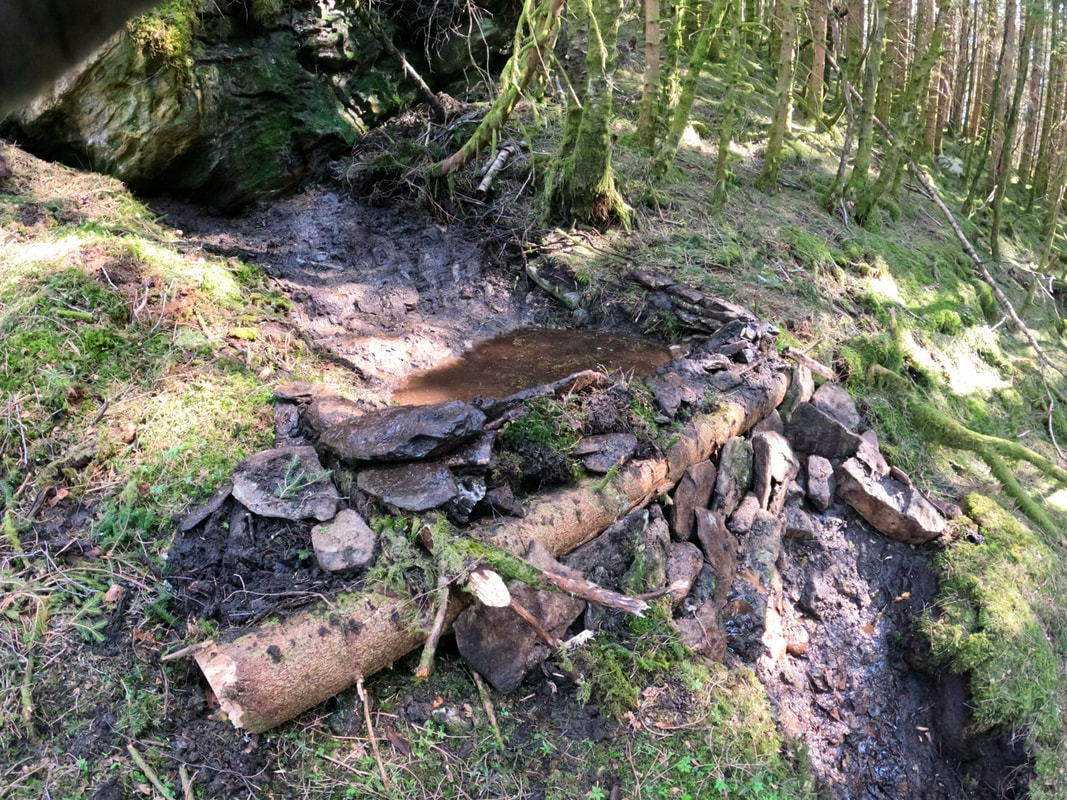
PAA Sketch #004: Fountain
Tools: A hand saw Materials: Found dead trees and rocks Dimensions: L x W x H Time: 2022-04-24, ~6 hours Location: 61.35848, 5.41425 Notes: Fountain is not a finished product, but a collaborative process undertaken with the natural environment. Through its construction, a snowmelt runoff stream was dammed using locally available natural materials to create a small water reservoir, with the intention that it continuously be altered by the water running through it. As the water runs through it, more materials will be caught between the layers of rocks that comprise the bulk of its structure, and as that material builds up the reservoir will be able to hold more water, which will get clearer over time, while purifying the snowmelt that pours from Fountain’s face. The reservoir adds to the capacity of the location by creating a space where water is able to remain long after the snow has disappeared from the mountaintop, giving an enhanced capacity for flora and fauna to live in the vicinity of Fountain. |
|
|
|
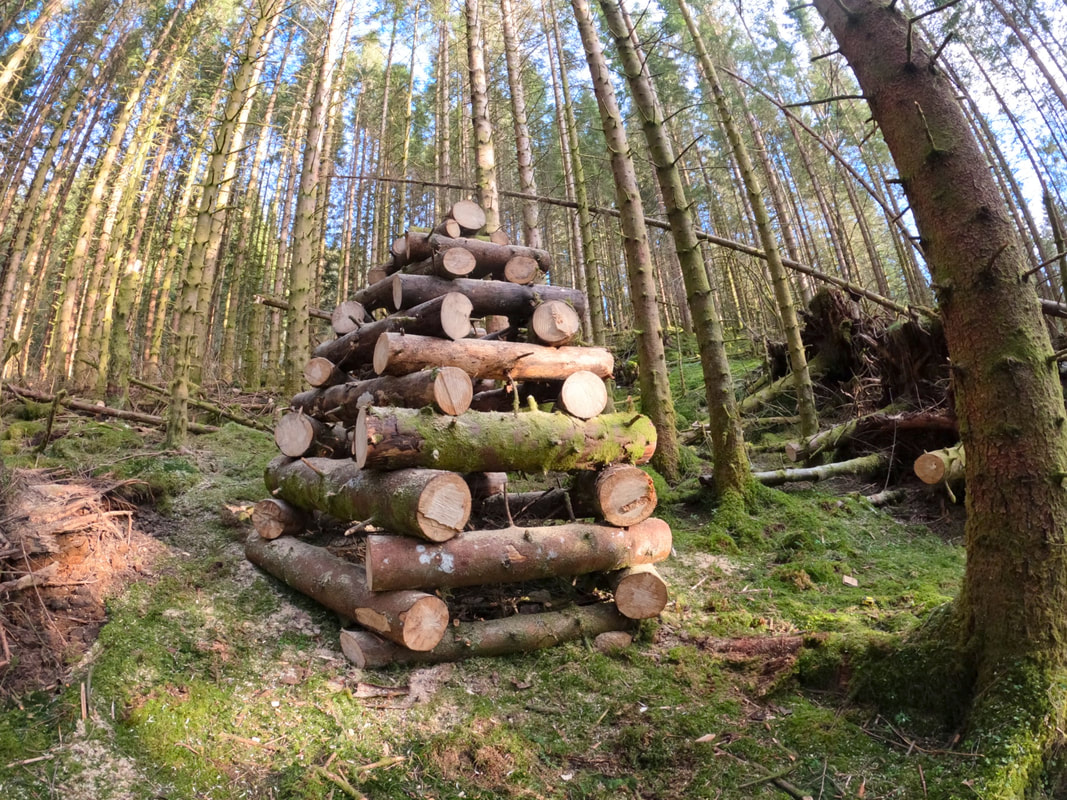
PAA Sketch #005: Hive
Tools: A hatchet, chainsaw and a tape measure Materials: Found dead trees Dimensions: 2.5m x 2.5m x 2.5m Time: 2022-04-27, ~8 hours Location: 61.35887, 5.40891 Notes: This sketch uses a notching system to stack logs in a hexagon shape, creating a structure which is stable, incredibly strong and long lasting. Small spaces created by its structure create places where small animals can enter and exit from, meaning that the forest’s small fauna can use it as a play-space, sanctuary or shelter. Due to the girth of the wood and methods used in Hive’s construction, it will take a long time to melt back into the forest, as it is slowly taken over and modified by moss as well as mycelium. |
PAA Sketch #006: Deadfall
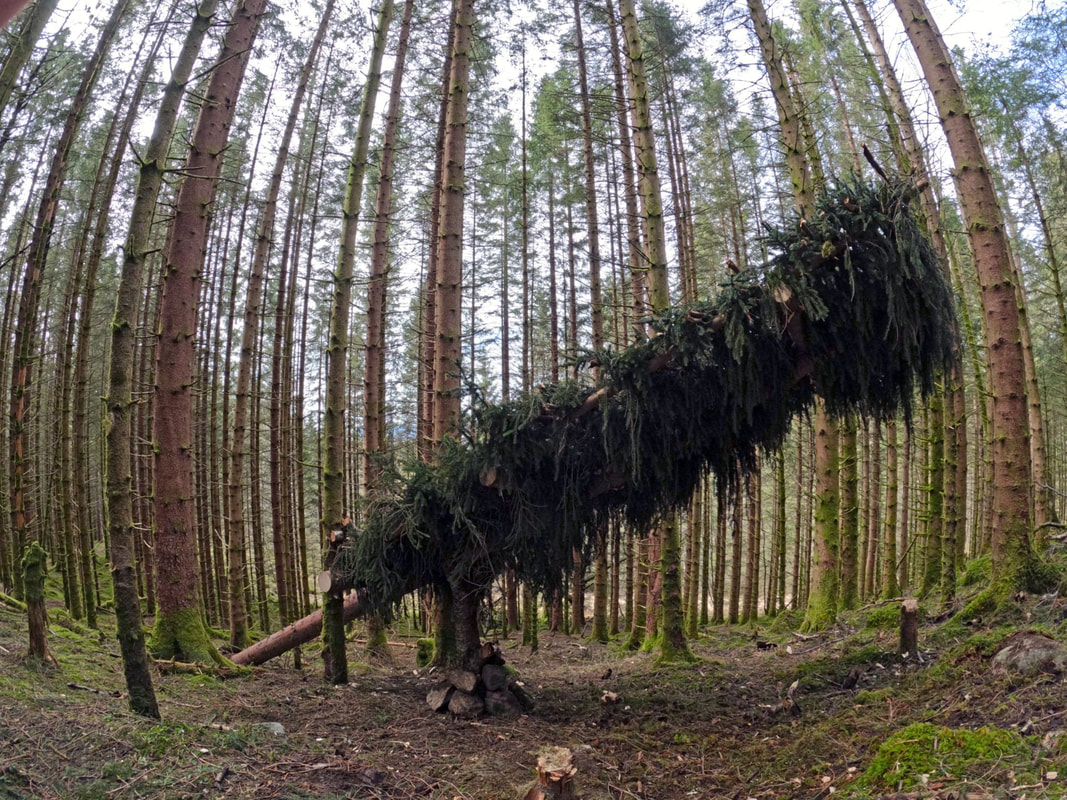
Tools: A hatchet, hand saw and tape measure. Materials: Found dead trees and rocks Dimensions: 8m x 1.65m x 2.5m Time: 2022-04-29, ~6 hours Location: 61.35847, 5.4082 Notes: Deadfall in the short term is a kind of shelter, and in the long term a kind of trap. The pine branches - which comprise the bulk of the upper part of its structure - have a surface area exceeding that of a naturally occurring tree, which means that the sketch passively collects more condensation at night, drips more water onto the forest floor below it, and causes the soil to be moister. In addition to this, Deadfall is positioned to shade the ground below it. Thus the sketch creates a habitat which is wetter and darker than that of the surrounding landscape, creating an improved habitat for those species which prefer dark and wet environments, such as mycelium and bacteria. This enhanced habitat means that the main support of the structure will rot faster than it would normally, and when it does Deadfall will collapse to the ground. |
|
|
|
PAA Sketch #007: Bouffant
Tools: A hatchet, chainsaw, shovel and a hand saw Materials: A dead apple tree and stones Dimensions: 2.5m x 2.5m x 2.5m Time: 2022-05-01, ~6 hours Location: 61.35912, 5.41276 Notes: The sketch uses a single fallen dead apple tree, and some nearby stones, for the entirety of its materials. A woven mass of branches creates the bulk of the structure, which protects the floor inside from both predation as well as too much sunlight. The floor is comprised of disks cut from the trunk of the dead apple tree, already inoculated with natural local mycelium. The disk format provides more surface area for the mycelium to spread laterally, thus producing greater numbers of mushrooms, resulting in more spores, and therefore an enhanced capacity for the mycelium to reproduce and spread. Thus the architecture is a reorganization of the preexisting materials in order to accommodate, protect and amplify the capabilities of the mycelium colony. |
PAA Sketch #008: Longhouse
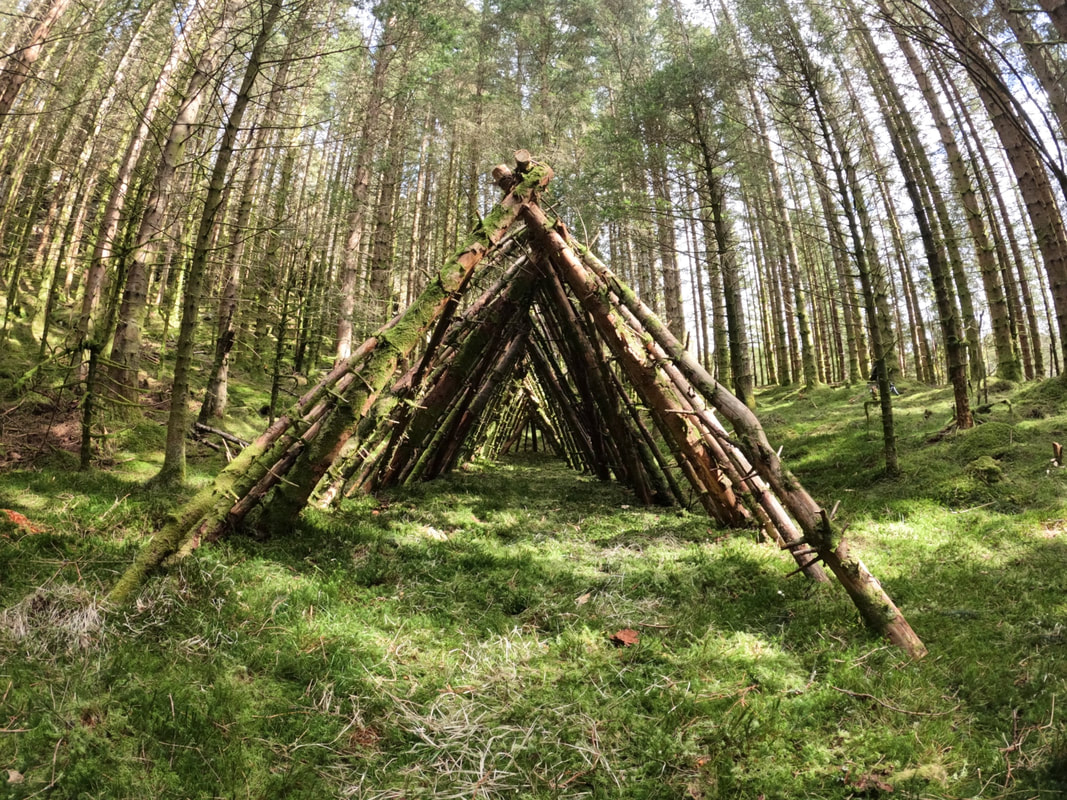
Tools: A hatchet, handsaw, shovel and tape measure Materials: Found dead trees Dimensions: 8.8m x 2.8m x 2.8m Time: 2022-05-03, ~6 hours Location: 61.35745, 5.40796 Notes: Longhouse is a structure built for air to flow through from all directions, as well as a super-scaffolding to be utilized and inhabited by the forest’s arachnid population. Situated in a small mossy clearing, the structure is built at an expected nexus point of flying insect activity. The structure itself provides much more surface area and variety of angles than naturally growing trees. Thus Longhouse provides considerably more places for spiders to build webs, as well as opportunities for a much larger population to occupy a much denser footprint. |
In planning and designing Post-Anthropocene Architecture, one cannot just think about how the structure will be realized, but needs to think about the past and the future of that structure: the past being the history and the context of the materials to be used; and the future being how the landscape and its inhabitants, the weather as well as time itself are going to affect those materials, their connection points and the structure as a whole. Thus, Post-Anthropocene Architecture is not a design for the present but a design to be realized across much greater expanse of space-time, and with a much lesser degree of control, than humans are used to.
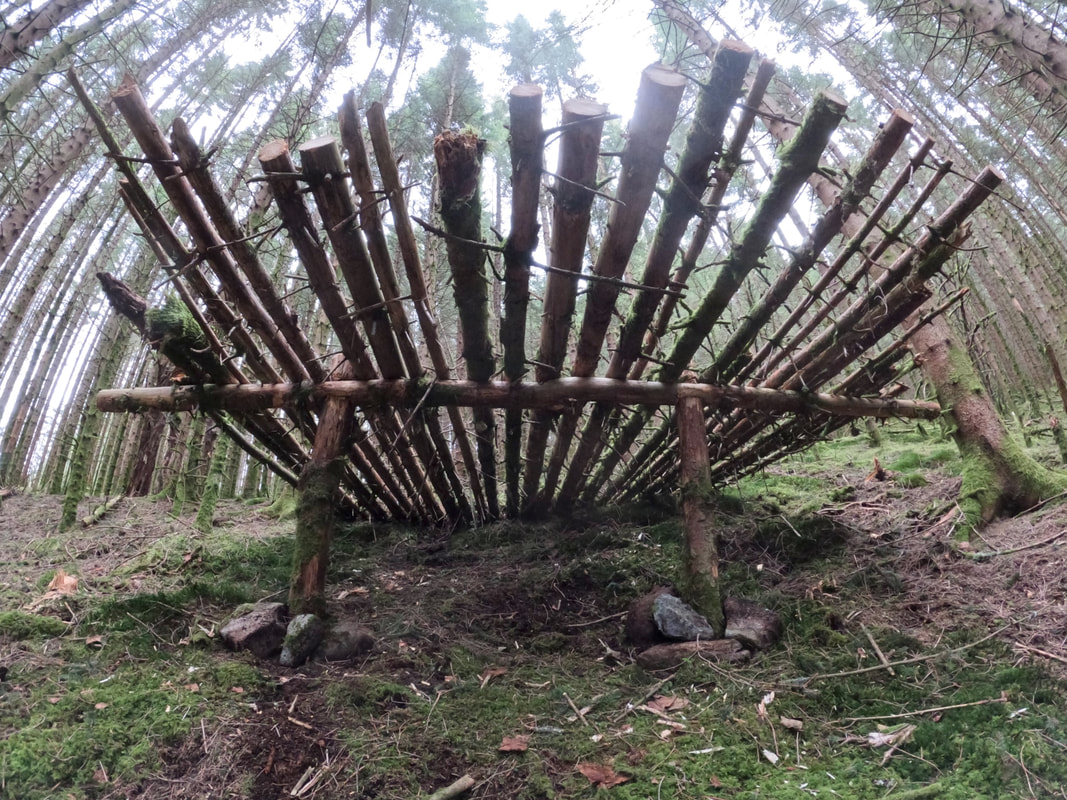
PAA Sketch #009: Plateau
Tools: A hatchet, shovel, handsaw and tape measure Materials: Found dead trees, stones and forest debris Dimensions: 4.5m x 4.5m x 1.5m Time: 2022-05-04, ~4 hours Location: 61.35793, 5.41241 Notes: Plateau is a platform constructed out of fallen dead trees, joined together and dug into the hillside to modify a small part of the existing landscape. The sketch levels the existing terrain while also creating a space underneath - essentially doubling its square meterage. The constructed platform is not immediately usable as it needs time for the forest debris to build up on its surface; but in doing so will camouflage the structure from certain angles and provide new habitat for moss, lichen and other plant life; while also providing a sheltered space underneath for different kinds of flora and fauna to occupy. |
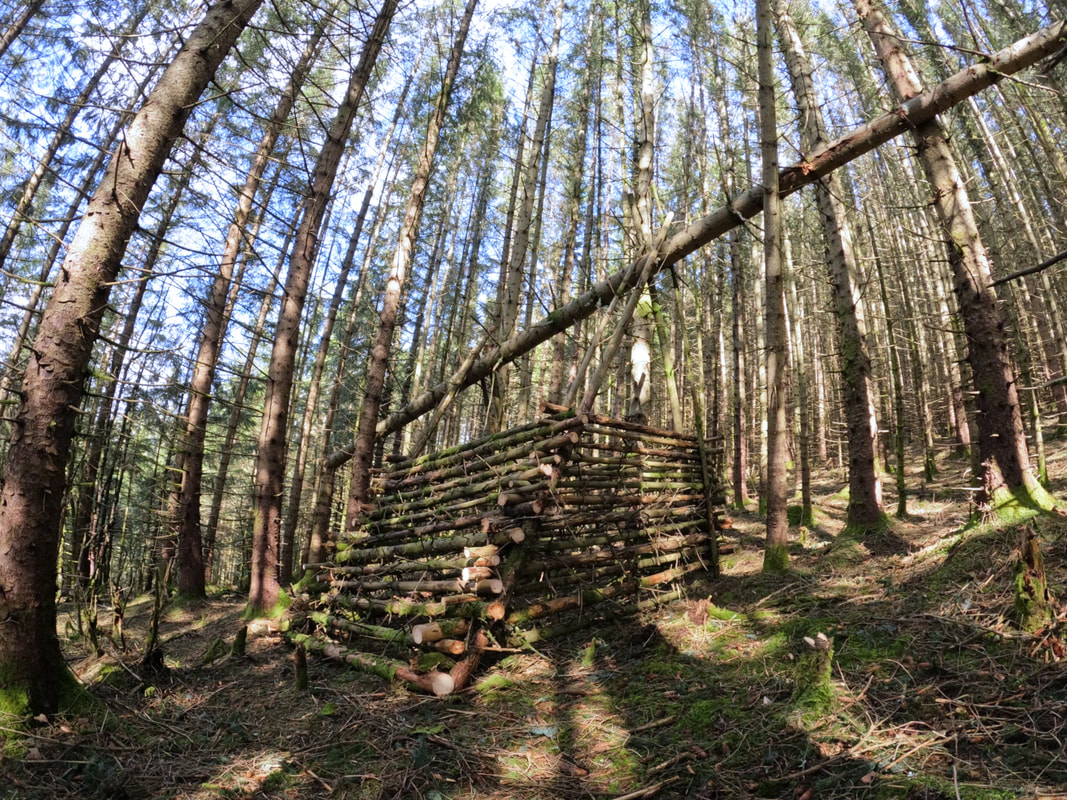
PAA Sketch #010: Basket
Tools: A hatchet, shovel, handsaw and tape measure Materials: Found dead trees Dimensions: 3.5m x 3.5m x 4.2m Time: 2022-05-07, ~7 hours Location: 61.3584, 5.41289 Notes: Basket is built in relation to how the site will change in years to come, how it will be used by animals in the meantime, as well as how the natural accumulation of matter is important to the forest floor. The sketch utilizes the suspended tree above as a source of structural support, which gives Basket its asymmetrical slope and supports its walls. Over time however, the basis for this support will drop down and eventually fall, crushing two of the Basket’s walls. In this action, the material will be redistributed on the forest floor where it will become a more habitable environment for moss and mycelium. Basket will also act as a repository for material which falls from the canopy, acting as a collection device for leaves, branches, needles and bark. This will prepare the site with a foundation of moss and mycelium, that will be ready to spread to the sketch’s materials and the supporting tree when it eventually collapses. Until that time however, the structure can act as a safe territory for small animals to inhabit, to use as a play-space, or to flee to. |
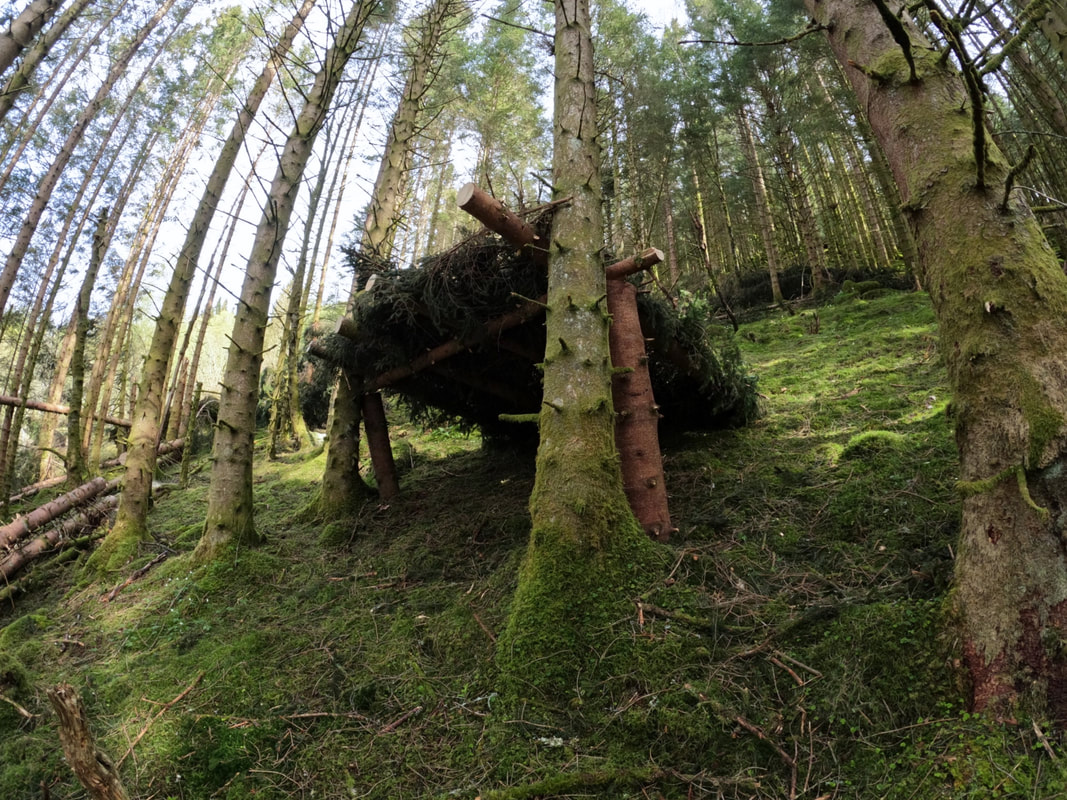
PAA Sketch #011: Ticky-town
Tools: A hatchet, chainsaw, handsaw and tape measure Materials: Found dead trees Dimensions: 4m x 4.5m x 1.8m Time: 2022-05-08, ~7 hours Location: 61.3588, 5.41124 Notes: It looks like a nice place to sit, relax, watch the forest go about its business, and maybe take a few selfies - but it’s a trap. The thick canopy which shades and camouflages the underside of Ticky-town is a habitat for ticks, spiders, mosquitos and other insects to wait for humans or other animals to come along. The dense cover, raised off of the wet ground, will accumulate over time as forest debris drifts down the hillside and falls from the canopy above - providing an increasing mass of material for predatory insects to live amongst. Thus the mass, supported by the sketch’s ample structure, will be able to support more and more insect life as it ages. While the animals that the sketch attempts to support are often seen as dangerous to human health and a general nuisance, they are nonetheless an important part of the local ecosystem. Therefore, in attempting to provide for species such as these, we are increasing our ability for non-anthropocentric thinking and supporting the health of the local environment, which in turn benefits us. |
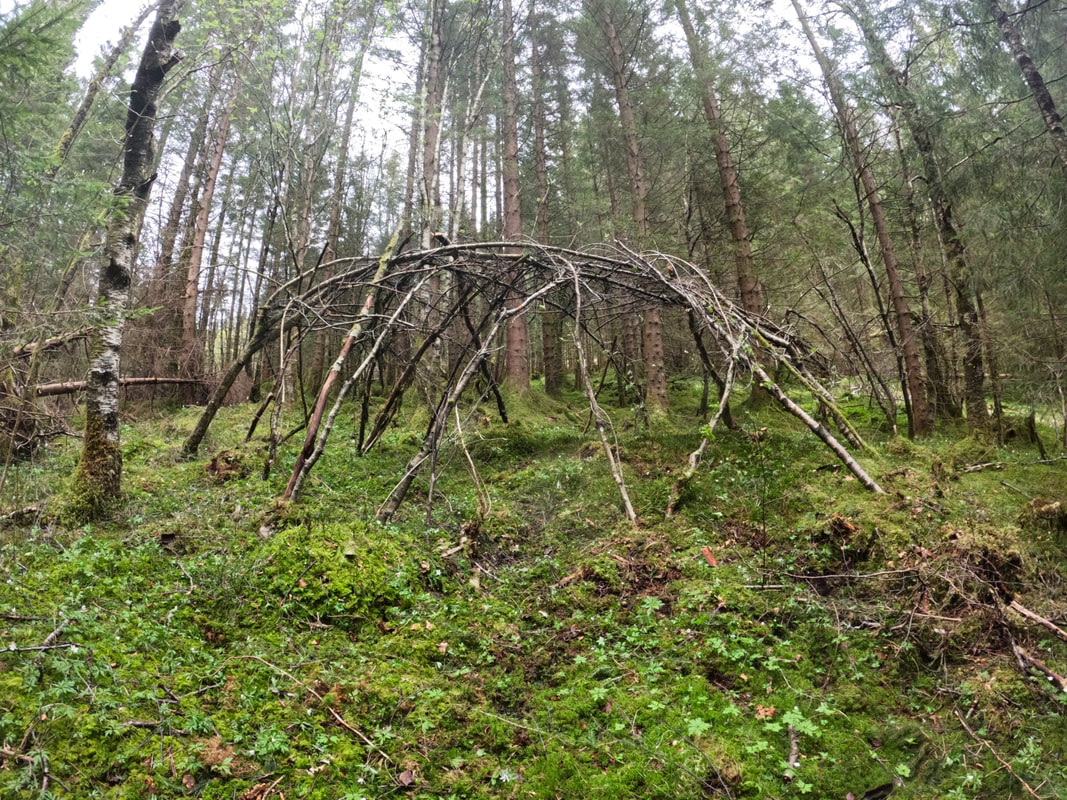
PAA Sketch #012: Coracle
Tools: A hatchet and handsaw Materials: Found dead trees and live trees Dimensions: 4.2m x 7.6m x 3m Time: 2022-05-09, ~4 hours Location: 61.35915, 5.40839 Notes: It doesn’t look like much - barely the skeleton of a structure and almost invisible amongst the trees. But Coracle is a scaffolding built using a combination of living trees as well as branches from dead trees. The dead branches are woven together to connect the live ones for the purpose of altering their shape and modifying their growth patterns. Coracle is not a structure in the present, so much as it will be one in the future. As the living trees grow; they will become rigid in their current shape, growing denser as well as fuller, as they fuse together to become a dome which filters out some of the sunlight from reaching the forest floor underneath. The living trees that make up Coracle will thus have a modest monopoly on the terrain below, ensuring that their roots have soil to occupy while leaving the surface area to be inhabited by peat moss and similar flora. |
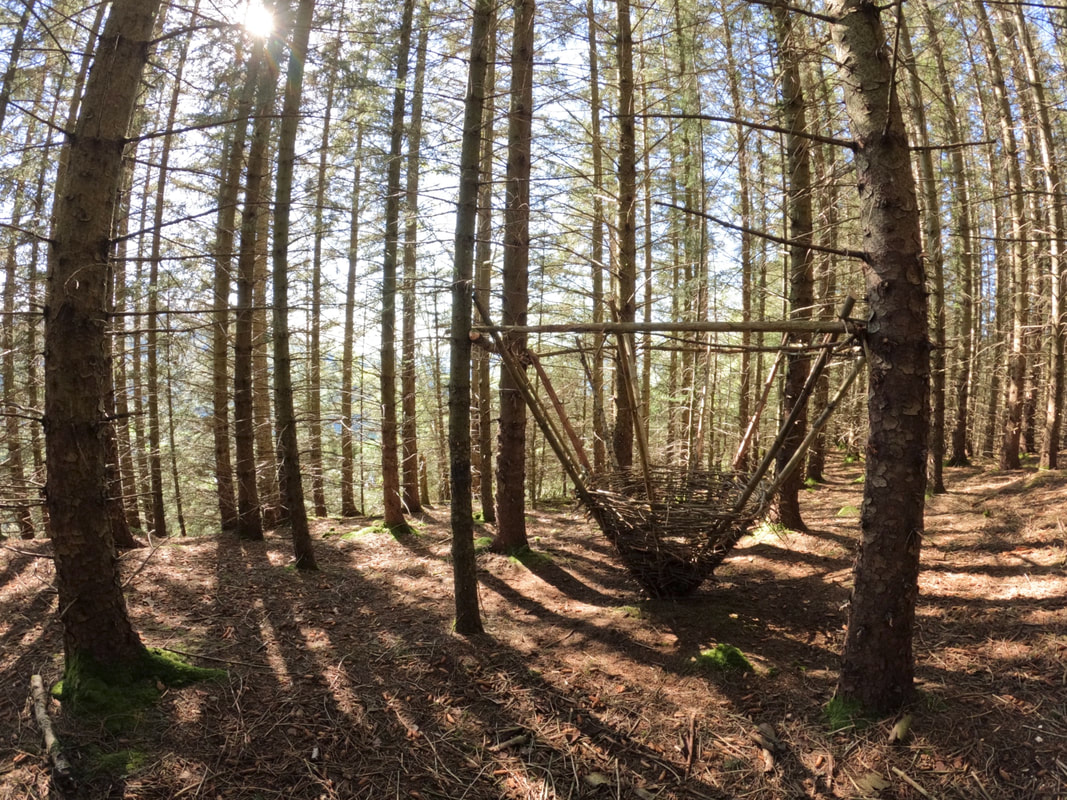
PAA Sketch #013: Funnel
Tools: A hatchet, handsaw and tape measure Materials: Found dead trees Dimensions: 3.5m x 3.5m x 2.5m Time: 2022-05-16, ~6 hours Location: 61.35783, 5.41526 Notes: Funnel is a large woven structure made to collect falling debris in a localized area. The work uses the surrounding trees as both structural elements as well as a source of natural materials. As the work grows and accumulates over time, the central cone will compost the debris faster than it would if there was no structure to concentrate it. The collaboration that happens between the structure which enables the composting, the trees which provide the materials for composting and the local species of bacteria which do the composting, thus creates a nexus point where a mass of rich and highly nutritious compost will be created, providing additional growth potential for other species of flora to occupy. |
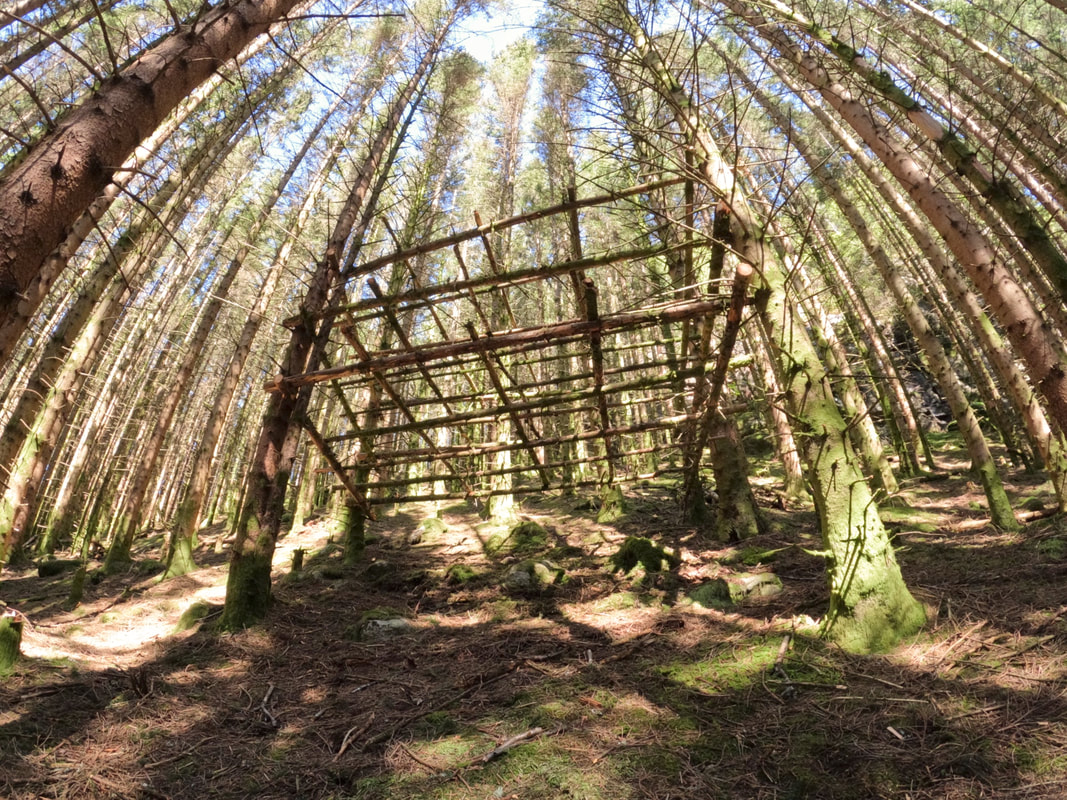
PAA Sketch #014: Trellis
Tools: A hatchet, handsaw and tape measure Materials: Found dead trees Dimensions: 5.3m x 5m x 4.8m Time: 2022-05-17, ~5 hours Location: 61.35781, 5.41401 Notes: Using minimal materials to occupy a maximum volume of space, Trellis functions as a kind of scaffolding built to be utilized by the forest’s arachnid population. The structure, a grid presented in four spatial dimensions, enhances the capacity of arachnids by its myriad of points which can be attached to, and the openness of its construction. Additionally, Trellis will rise higher and higher as the trees, which provide the structure with its vertical support, grow over time. |
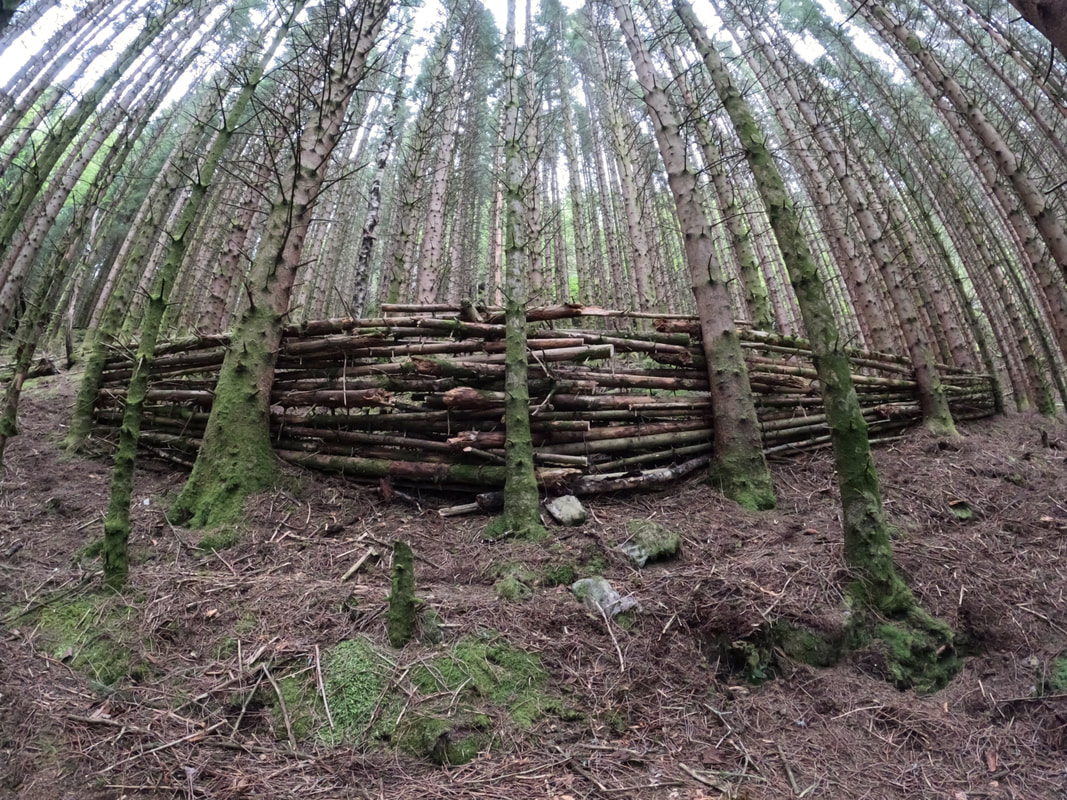
.PAA Sketch #015: Dam
Tools: A handsaw and tape measure Materials: Found dead trees Dimensions: 15m x 2.5m x 1.75m Time: 2022--5-18/19, ~5 hours Location: 61.35728, 5.41479 Notes: Situated on a steep hill with a lot of fallen trees and parallel to a game trail, Dam was constructed out of that existing debris in order to protect a section of the game trail from being blocked by future debris. The structure is able to accumulate future debris that rolls down the hill, and in doing so has the potential to maintain its size and even grow over time. The mass of found dead trees Dam that is constructed out of will be inhabited and broken down by insects, mycelium and bacteria, but as they do so, the shape of the landscape will be changed: the trees will decay and turn back into soil, as more trees will accumulate, and so on in perpetuity. |
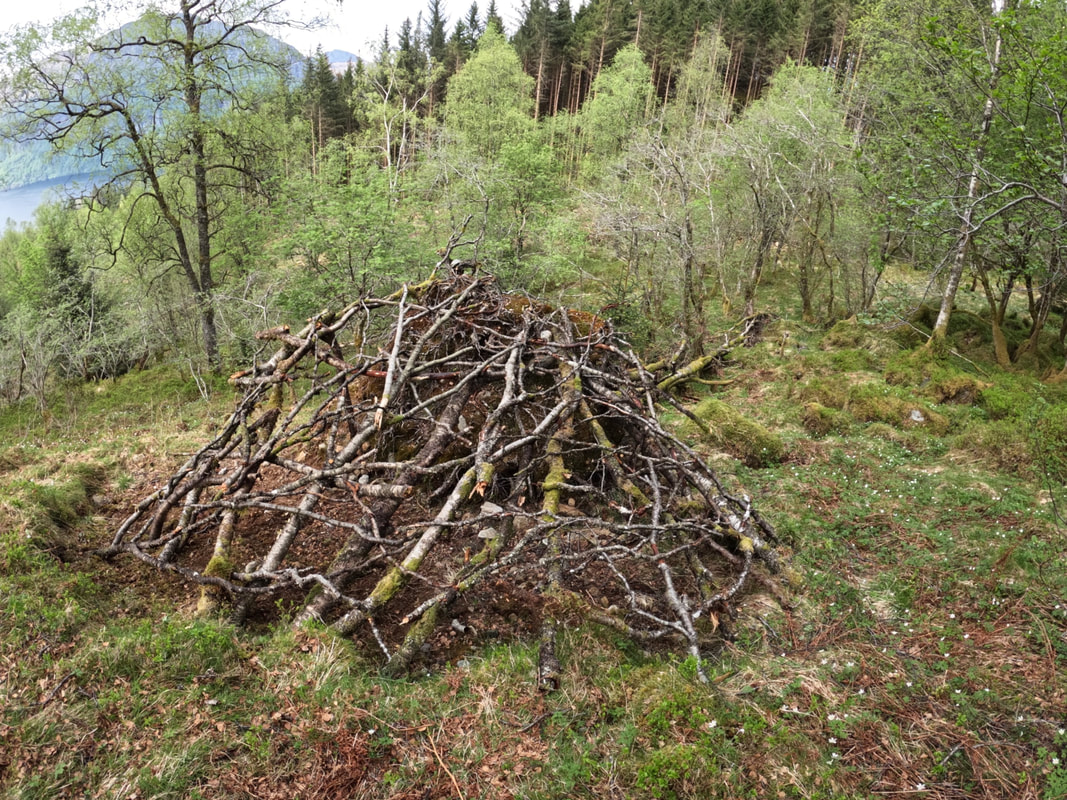
PAA Sketch #016: Tiger-trap
Tools: A handsaw Materials: Branches from a dead tree Dimensions: 4.75m x 4.2m x 2m Time: 2022-5-20, ~5 hours Location: 61.35981, 5.41311 Notes: Tiger-trap utilizes the branches of a fallen tree to bridge and fill in the negative space left by its overturned root ball The structure created through the tangling and weaving of its branches creates a prosthetic extension, reconnecting the root ball with the ground. In the short term, Tiger-trap can be used by small animals for overhead cover, as a perch or a playspace, while in the long term can collect debris and plant growth - eventually accumulating enough to create the illusion that the ground continues directly to the uppermost edge of the root ball. |
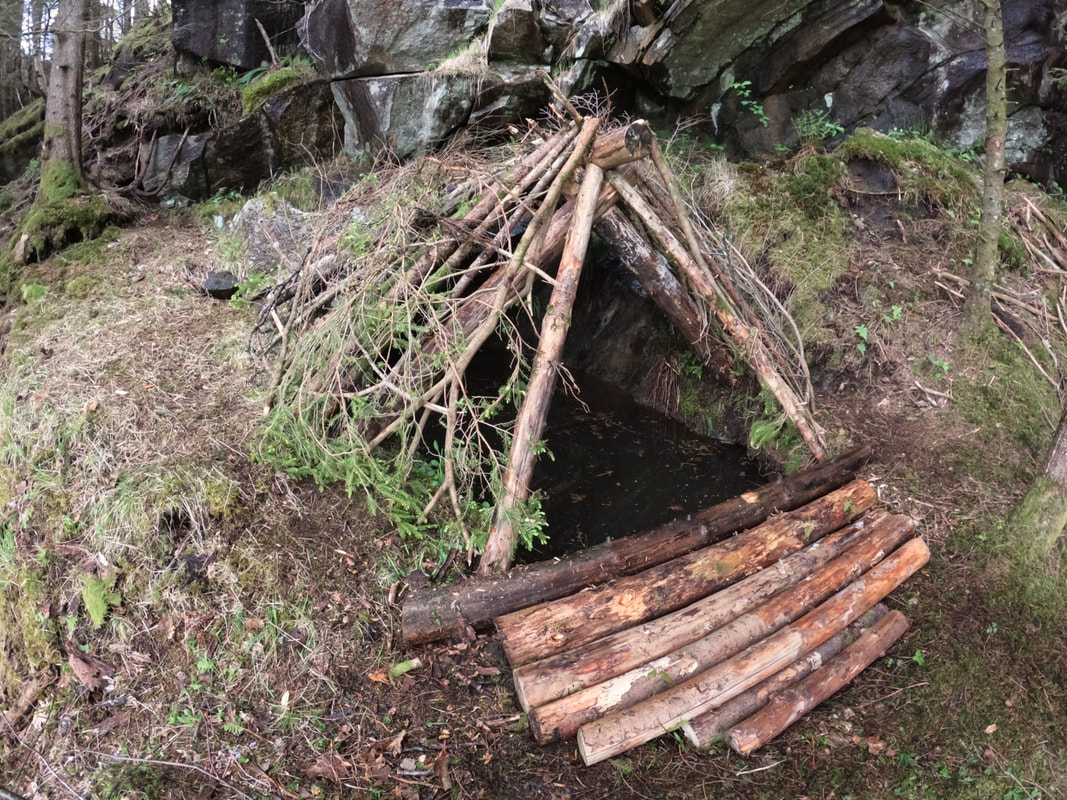
PAA Sketch #017: Tadpole-hole
Tools: A hatchet, handsaw and tape measure Materials: Found wood and dead trees Dimensions: 4.5m x 3.4m x 2.5m Time: 2022-5-21, ~4 hours Location: 61.35845, 5.40493 Notes: Tadpole-hole is a structure utilizing found wood, dead trees and the existing landscape to create a roof-like structure to cover a small pond. The structure prevents debris from falling off of the cliff situated directly behind the pond and into the water. With less organic material in the pond, there will consequently be less bacteria to decompose it, and thus less bacteria to use the oxygen in the water. Tadpole-hole therefore minimizes the deoxygenation of the water, making the pond more habitable for the tadpoles and other small fauna living in it. |
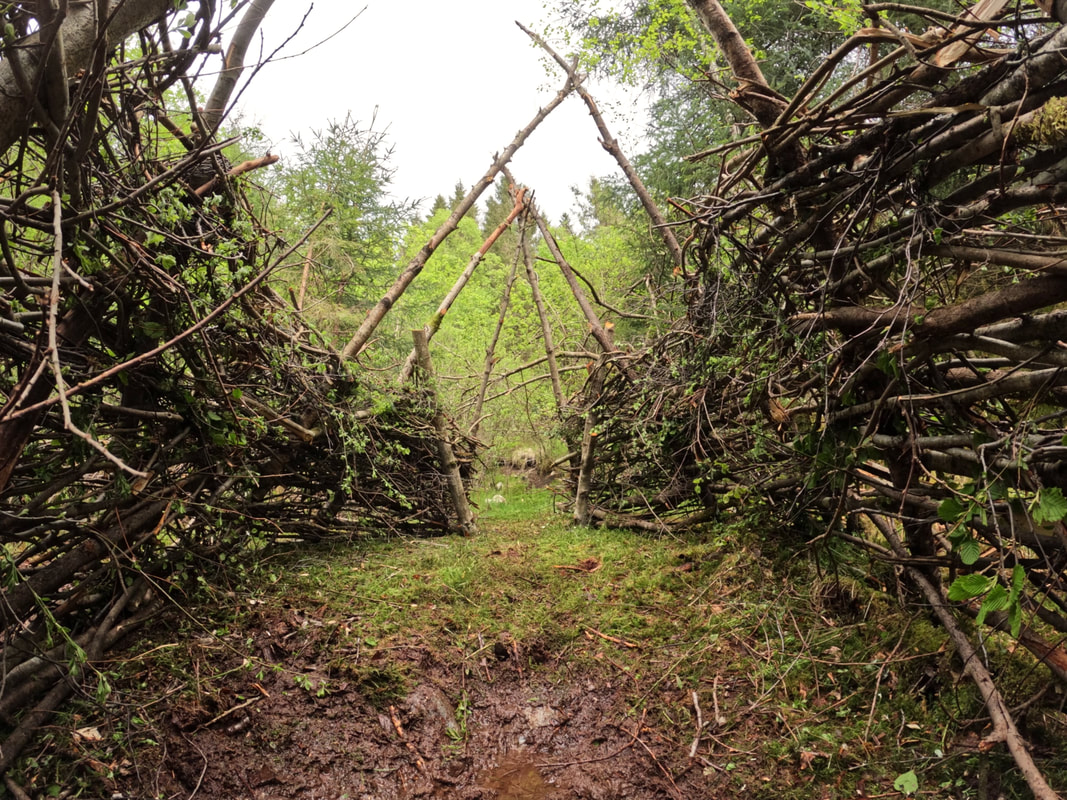
PAA Sketch #018: Channel
Tools: A hatchet, handsaw and tape measure Materials: Trimmed branches and found dead trees Dimensions: 4m x 2.5m x 2.5m Time: 2022-05-28, ~5 hours Location: 61.35897, 5.40779 Notes: Channel is a woven structure made out of branches and found dead trees to create an ovalesque corridor within the forest. The sketch is a structure which will allow for the forest on either side to grow up to its woven walls while ensuring that wild game has a corridor that can be traversed. Channel encourages and restricts the movement happening within its vicinity, and in doing so creates a collaborative situation between the structure, environment and its inhabitants which changes the landscape as a whole. |
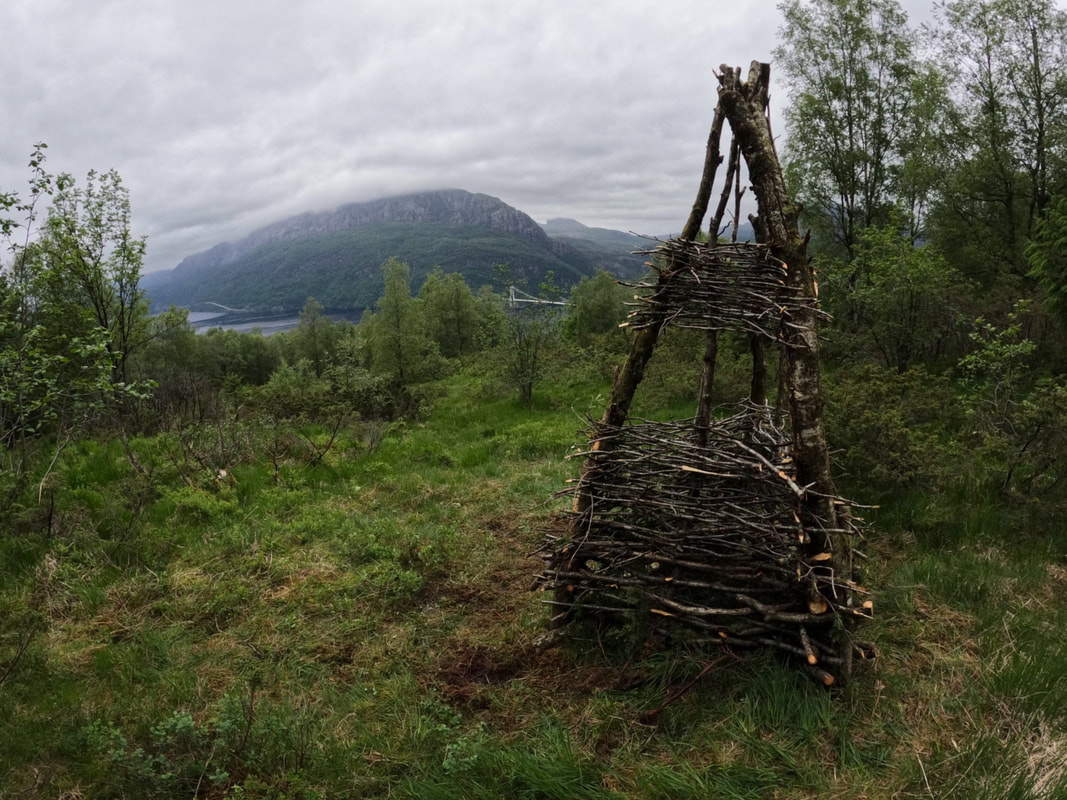
PAA Sketch #019: Juniper Temple
Tools: A hatchet and handsaw Materials: A single dead tree and live juniper bushes Dimensions: 1.6m x 1.6m x 2.7m Time: 2022-06-22, ~4 hours Location: 61.3587, 5.41604 Notes: Juniper Temple uses a single naturally fallen tree as a source of materials in the creation of a pyramidal structure which incorporates the site's existing juniper bushes into its woven structure. Thus the sketch provides a scaffolding that the juniper can attach to, climb upon and utilize while the juniper also provides a hearty root system to anchor and stabilize the structure. The sketch is not very large, but is located in a very grassy hillside with few trees taller than it nearby, meaning that the structure can also serve as a perch or platform for birds to survey the surroundings from. |
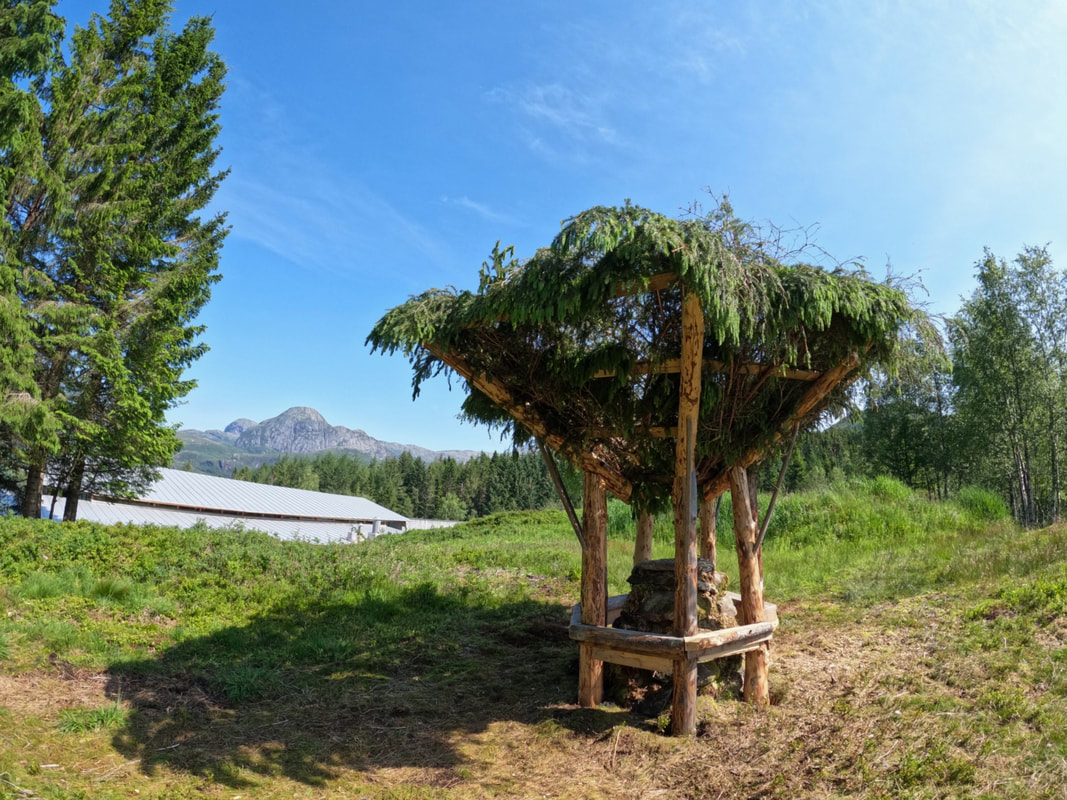
PAA Sketch #020: Waypoint
Tools: A hatchet, handsaw, chainsaw, and a shovel Materials: Logs, reclaimed wood, stones, moss, reused nails Dimensions: 5.3m x 5.3m x 2.85m Time: 2022-06-20, ~6 days Location: 61.35918, 5.40386 Notes: Waypoint is a Post-Anthropocene Architecture designed to funnel rainwater and snowmelt from its roof, collecting it in its central well, thereby creating a localized oasis in otherwise dry surroundings. The well is composed of a hollow tower of rocks which have been set in place by using moss as an organic mortar. The structure is located in a site frequented by deer and birds, giving an opportunity for those animals to access the water that collects in the well, as it seeps out from between the rocks. The installation utilizes knowledge gained through the design and construction of the previous 19, in order to create a more long-term structure. |
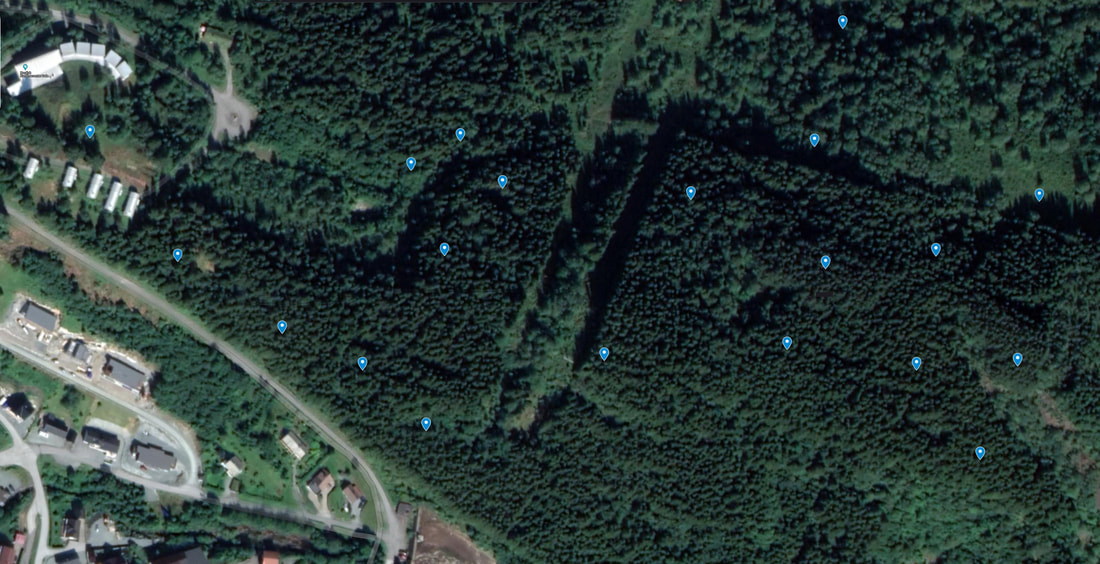
This artistic and academic research was conducted by Justin Tyler Tate while at Nordisk Kunstnarsenter Dale (Nordic Artists Centre Dale) from 2022/04-05 until 2022-06-30, and was supported by Nordic Artists Centre Dale.